The Different Types of Data Centers in the U.S.
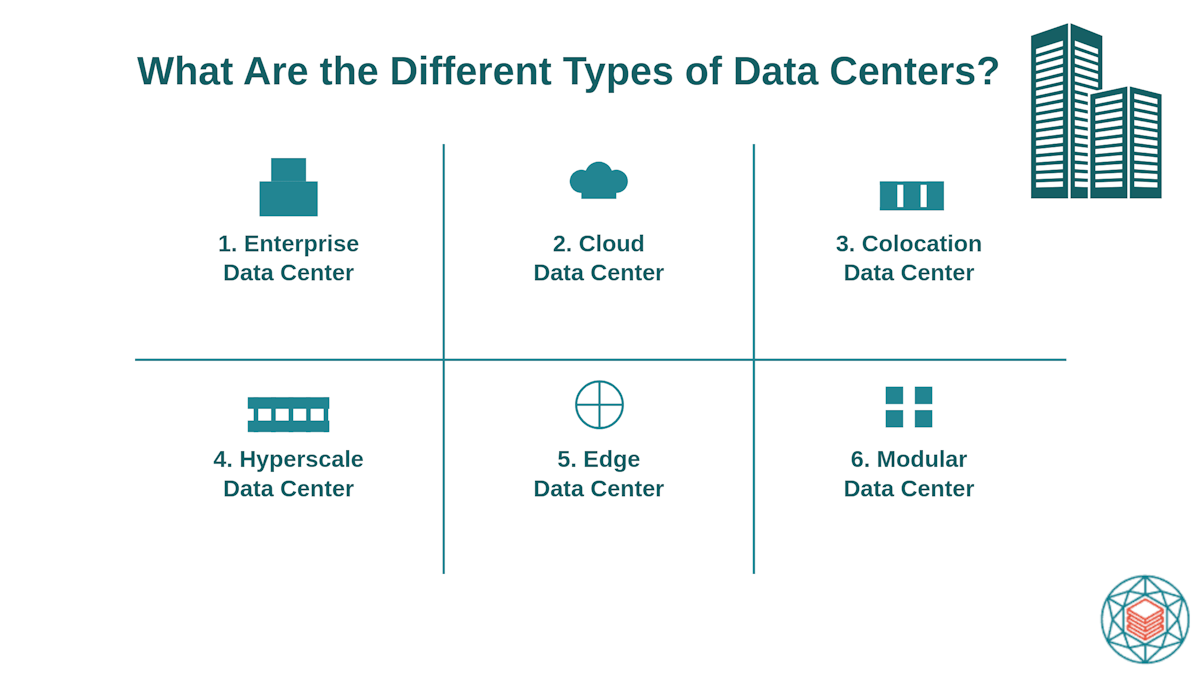
Every time you send an email, stream a video, or log into a cloud app, a data center is working behind the scenes. These facilities store, process, and distribute the data that powers modern life.
But not all data centers are the same.
In the United States, data centers come in several distinct types—each designed for different users, scales, and purposes. Understanding these differences is key to understanding the digital economy, local infrastructure impacts, and emerging policy debates.
What Is a Data Center?
At its most basic level, a data center is a physical facility that houses computing equipment like servers, storage systems, and networking hardware. These systems work together to run applications and manage data for everything from school systems to global AI platforms.
The 5 Main Types of Data Centers
1. Enterprise Data Centers (Private Facilities)
Enterprise data centers are owned and operated by a single organization for its own use.
These are often used by:
Government agencies
School systems
Hospitals
Financial institutions
They can be located on-site (on-premise) or in a dedicated remote facility.
Key characteristics:
Full control over data and security
Custom-built for specific internal systems
Often required for compliance or privacy reasons
Many large organizations rely on enterprise data centers to manage sensitive operations and maintain direct oversight of their IT infrastructure.
2. Colocation Data Centers (Shared Infrastructure)
Colocation data centers (“colos”) are shared facilities where multiple organizations rent space for their servers. Instead of building their own data center, companies place their equipment inside a professionally managed facility.
Key characteristics:
Shared power, cooling, and security systems
Flexible scaling (rent space as needed)
High connectivity to networks and cloud providers
These centers act like digital real estate, enabling businesses to access reliable infrastructure without the cost of building their own facility.
3. Hyperscale Data Centers (Cloud & AI Infrastructure)
Hyperscale data centers are massive, industrial-scale facilities operated by major technology companies.
Examples include:
Amazon Web Services (AWS)
Microsoft Azure
Google Cloud
Meta (Facebook)
Key characteristics:
Extremely large (thousands of servers)
Built to handle global demand
Power cloud computing, streaming, and AI systems
These facilities are critical to the modern internet—and are major drivers of energy use, land development, and infrastructure expansion in the U.S.
4. Edge Data Centers (Local & Low-Latency)
Edge data centers are smaller facilities located close to users and devices.
Their purpose is to reduce delay (latency) and improve performance for real-time applications.
Common use cases:
5G networks
Streaming services
Internet of Things (IoT) devices
Smart infrastructures
Key characteristics:
Smaller and distributed
Located in or near cities
Designed for fast response times
Edge data centers are becoming more important as technologies like autonomous systems and real-time analytics expand.
5. Modular Data Centers (Portable & Scalable)
Modular data centers are pre-built, portable units, often housed in container-like structures.
Key characteristics:
Quick to deploy
Scalable in increments
Used in remote or temporary environments
They are especially useful for rapid expansion or specialized projects where building a full facility is not practical.
Additional Models: Cloud and Hybrid
In practice, many organizations use a mix of these approaches:
Cloud data centers deliver services over the internet, often running within hyperscale facilities
Hybrid models combine private (enterprise) systems with cloud or colocation services
This blended approach is increasingly common as organizations balance control, cost, and scalability.
Data Center “Tiers”: Measuring Reliability
In addition to type, data centers are also classified by reliability levels, known as “tiers”:
Tier I - Basic infrastructure, limited redundancy
Tier II - Some backup systems
Tier III - High availability, maintenance without shutdown
Tier IV - Full fault tolerance and maximum reliability
These tiers reflect how resilient a facility is to outages and failures and are widely used as a benchmark across the industry.
Why This Matters
Data centers are not just technical facilities—they are critical infrastructure.
Different types have very different impacts:
Hyperscale centers drive large-scale energy and water demand
Colocation hubs concentrate infrastructure in urban areas
Edge facilities shape local zoning and deployment decisions
Enterprise centers impact public-sector operations and data governance
As demand for cloud computing and artificial intelligence grows, the type of data center being built—and where—has become a major economic, environmental, and policy issue across the United States.
Conclusion
The U.S. data center landscape is diverse, but most facilities fall into a few core categories:
Enterprise (private control)
Colocation (shared infrastructure)
Hyperscale (cloud and AI scale)
Edge (localized computing)
Modular (portable and flexible)