Data Center Project Kill Switches
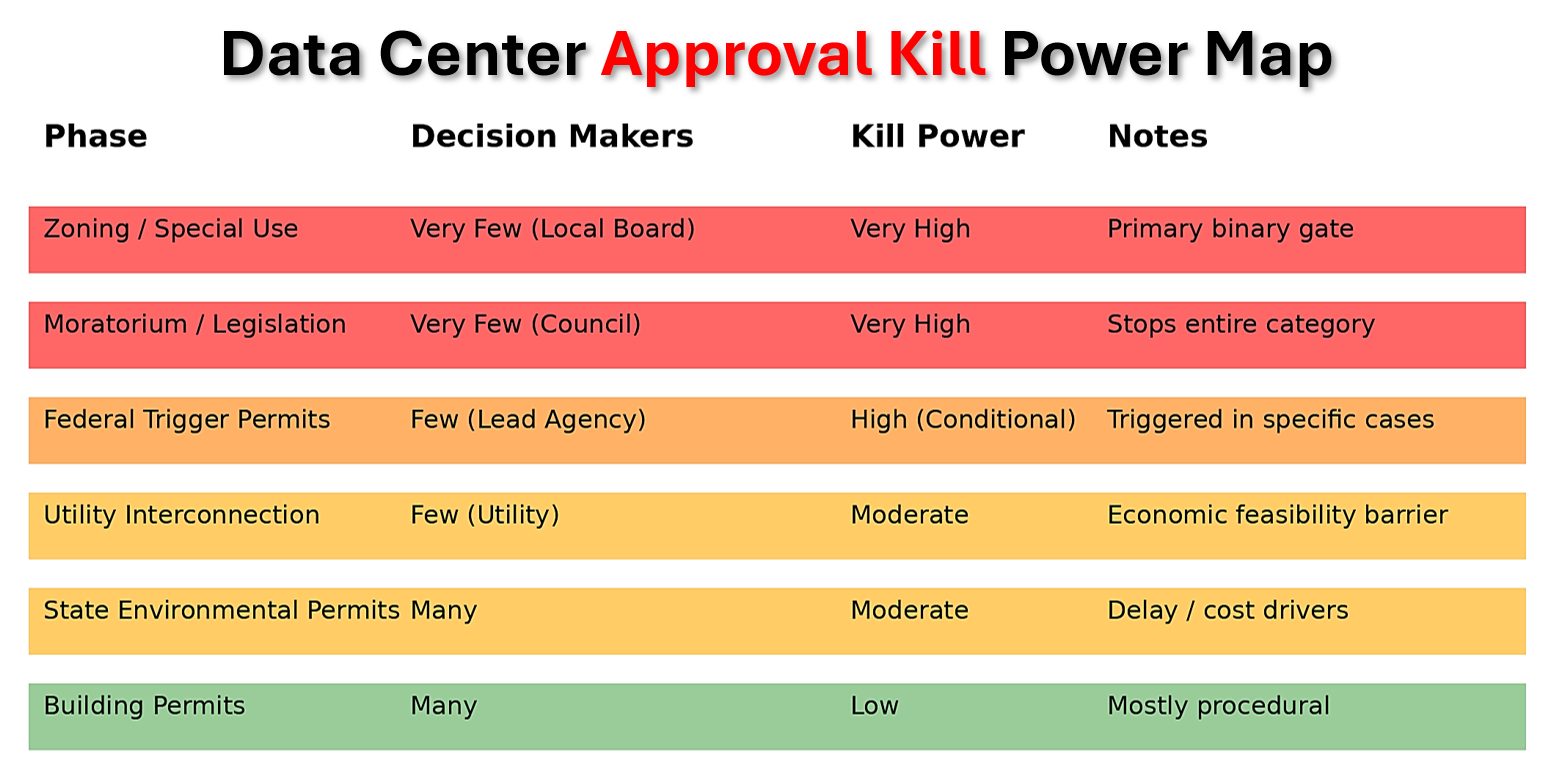
Data Center approval levels, from easiest to hardest to kill.
Most efficient “kill switches”
Local zoning decision
Municipal or county moratorium
Single-trigger environmental constraints (wetlands, endangered species)
Less efficient (but slower choke)
Multi-agency environmental review
Permit stacking
Phased approvals
High-Level Insight
Across U.S. data center development, early-stage land use and select environmental triggers are the most fragile points:
Zoning / land-use entitlements → single board or council can kill it
Targeted environmental permit triggers → one agency decision can block
Later phases (building permits, multi-permit compliance) → death by delay, not a single veto
1. Zoning & Land-Use Approval (MOST “KILLABLE”)
Why it’s fragile:
Typically decided by one local body:
Planning commission
Zoning board
City council / county board
Data centers often require:
If denied, the project is effectively dead or must restart elsewhere.
Key structural factors:
Ambiguous classification (industrial vs commercial) creates discretion
Public hearings enable organized opposition
Approvals can be reversed or litigated on procedural grounds
Bottom line:
Few decision-makers (often <10 people)
Binary outcome (approve/deny)
Highest probability of outright project termination
2. Local Moratoria / Legislative Actions (Even More Concentrated)
Why it’s powerful:
A single governing body (city council, county legislature) can:
Impose a temporary ban on all data center approvals
Pause building permits and site plan approvals entirely
This has already been used widely in the U.S.
Bottom line:
Extremely small decision surface (simple majority vote)
Can stop entire categories of projects instantly
No need to evaluate project specifics
3. Federal “Trigger” Permits (Selective but Powerful)
These only apply if the project hits certain thresholds—but when they do:
Examples:
NEPA environmental review (EIS / EA)
Endangered Species Act consultation
Why this is a chokepoint:
A single federal agency decision can:
Deny a permit
Require mitigation that kills economics
Trigger litigation that stalls indefinitely
HOWEVER:
These are conditional—they only apply if Federal land, funding, wetlands, or protected species are involved.
Bottom line:
Still relatively few decision-makers (one lead agency)
But only triggered in specific scenarios
More often causes delays than outright denial
4. Utility / Grid Interconnection Approval
Why it matters:
Data centers require massive power (50–500 MW+)
Decision structure:
Typically controlled by:
One utility
Or a regional grid operator
Impact:
Can effectively kill the project if:
No capacity
Timeline is too long
Upgrades are uneconomic
Bottom line:
Few actors (sometimes one utility)
Not always a legal “denial” — more often a feasibility kill switch
5. Environmental & State Permitting (Diffuse Kill Power)
Includes:
Air permits
Water withdrawal/discharge
Waste and stormwater permits
Why these are weaker chokepoints:
Multiple permits across agencies
Issues can often be:
Mitigated
Redesigned
Sequenced
Bottom line:
Many decision-makers
Iterative approvals rather than binary votes
More likely to delay or increase cost than outright stop
6. Building & Construction Permits (LEAST “KILLABLE”)
Characteristics:
Highly standardized compliance process
Focus on:
Safety codes
Engineering approvals
These are procedural and follow established rules once zoning is secured
Bottom line:
Little discretionary power
Rarely used to kill a project outright